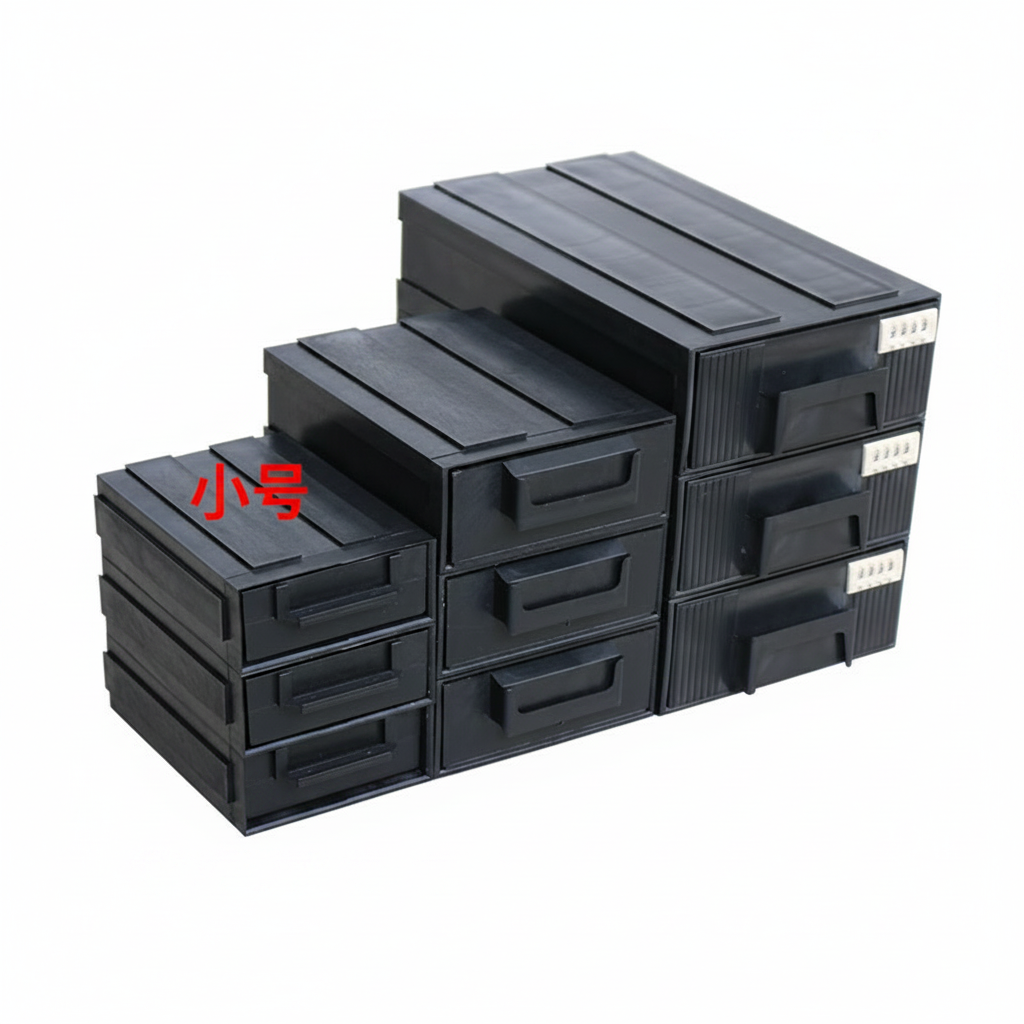
When ESD bins beat plain plastic bins
If your shelving is in an ESD Protected Area (EPA) or you store any non-bagged ESD-sensitive components (bare ICs, raw PCBs, unbagged sub-assemblies), plain plastic bins are an ANSI/ESD S20.20 violation — full stop.
ESD bin shelves replace plain plastic bins one-for-one in standard shelf systems. They look the same, mount the same, but the polymer is carbon-loaded dissipative PP at 10⁴-10⁹ Ω/sq, so any tribocharge picked up by the operator drains through the bin to the grounded shelf.
Sizes and rack compatibility
Small (175 × 110 × 75 mm) — small parts, screws, fasteners, individual ICs.
Medium (270 × 150 × 125 mm) — sub-assemblies, kits, components in cut tape.
Large (415 × 200 × 175 mm) — PCBs, modules, larger components.
Jumbo (540 × 305 × 220 mm) — full PCB sets, multi-PCB kits.
All sizes fit standard wire-shelf and steel-shelf racking on 18", 24", 36" and metric spacings.
5S color coding
Black (default) — general inventory.
Blue — incoming / receiving / not yet inspected.
Red — quarantine / rework / NCR holds.
Yellow — kitting and WIP.
Custom colors quoted at 500-piece MOQ.
All non-black colors use color masterbatch blended with the carbon-loaded dissipative compound, so the ESD rating is identical to the black baseline (carbon by itself is what gives the bin its conductivity — adding pigment does not affect it).
Grounding the rack
Bins are dissipative, not isolating — they drain charge to whatever they touch. To complete the EPA, the rack itself must be grounded to the same potential as your wrist-strap ground and your floor mat.
Steel racks: bond one upright to building ground with a 16 AWG wire. Wire shelves: bond the shelf wire directly. Plastic-coated shelf liners block grounding — remove them or use uncoated wire shelves where ESD bins sit.